Known limitations

Top  Previous  Next


There are situations that Pascal Analyzer currently cannot handle very well. Some of these limitations, but certainly not all, are:


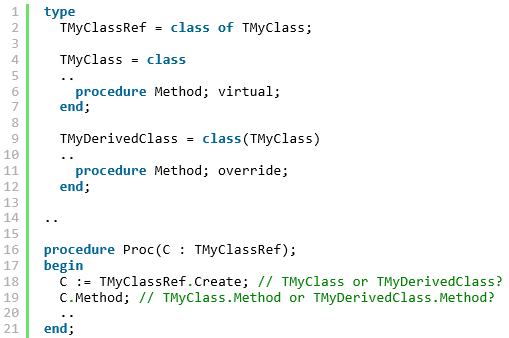
1. Objects that are created through a class reference cannot be resolved. The actual class is determined at runtime.


Example:


type

TMyClassRef = class of TMyClass;


TMyClass = class

..

procedure Method; virtual;

end;


TMyDerivedClass = class(TMyClass)

..

procedure Method; override;

end;


..


procedure Proc(C : TMyClassRef);

begin

C := TMyClassRef.Create; // TMyClass or TMyDerivedClass?

C.Method; // TMyClass.Method or TMyDerivedClass.Method?

..

end;


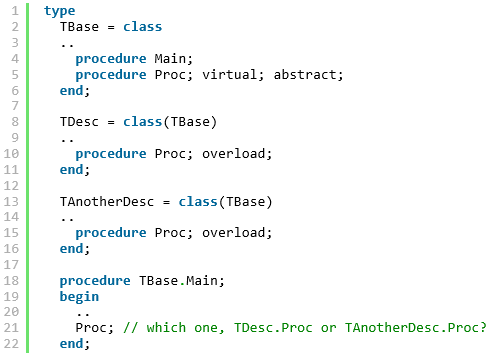
2. Methods that are marked as abstract in a base class and used in that class, cannot be resolved:


Example:
 

type

TBase = class

..

procedure Main;

procedure Proc; virtual; abstract;

end;


TDesc = class(TBase)

..

procedure Proc; overload;

end;


TAnotherDesc = class(TBase)

..

procedure Proc; overload;

end;


procedure TBase.Main;

begin

..

Proc; // which one, TDesc.Proc or TAnotherDesc.Proc?

end;


The actual usage of Proc is determined at runtime.


3. Assert calls are not excluded from the parsing process, unlike in Delphi, regardless if the $C- setting is active or not. This means that identifiers used in the Assert procedure call, will be registered, and appear in the reports.


Example:
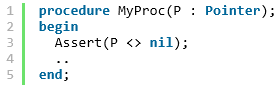
 

procedure MyProc(P : pointer);

begin

Assert(P <> nil);

..

end;


The parameter P will be registered and appear in the reports. When compiled by Delphi, this code line will be stripped out if $C- is defined.


4. Identifiers with generic parameters are in the reports written out on a special format:


Example:


TMyClass<T, W>

.. will be written as

TMyClass<2> (the number of parameters)


See also: